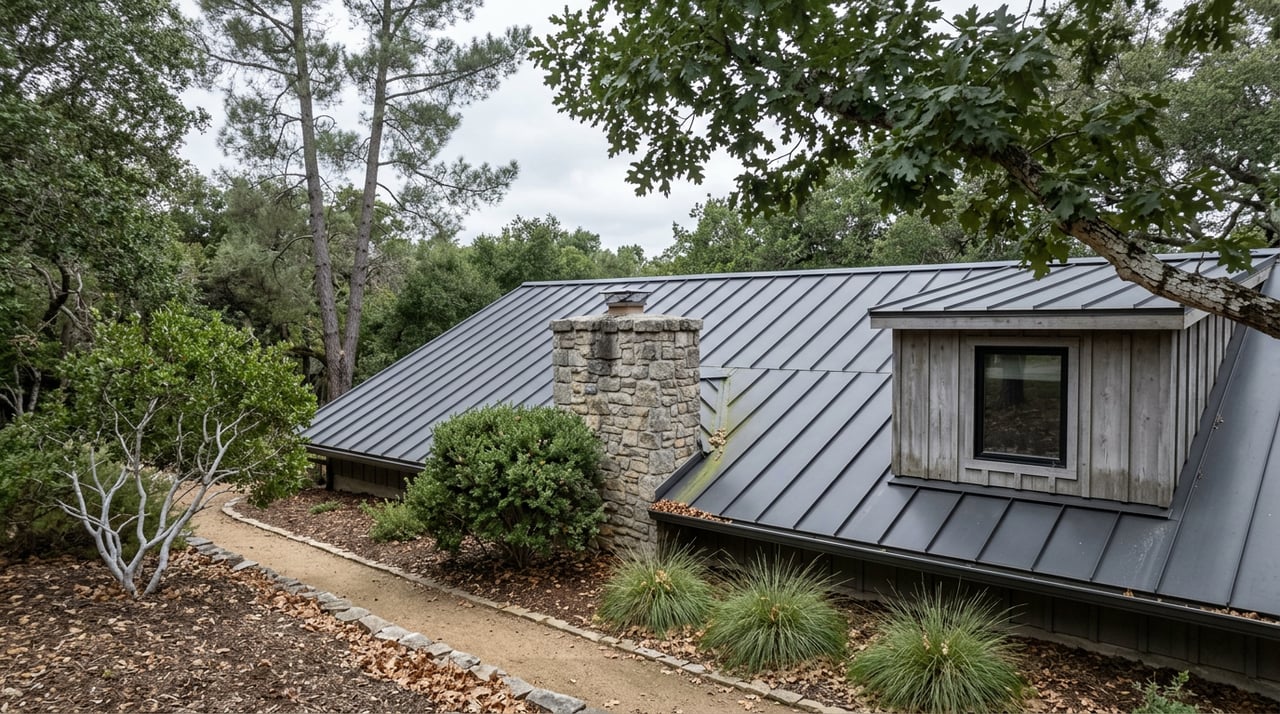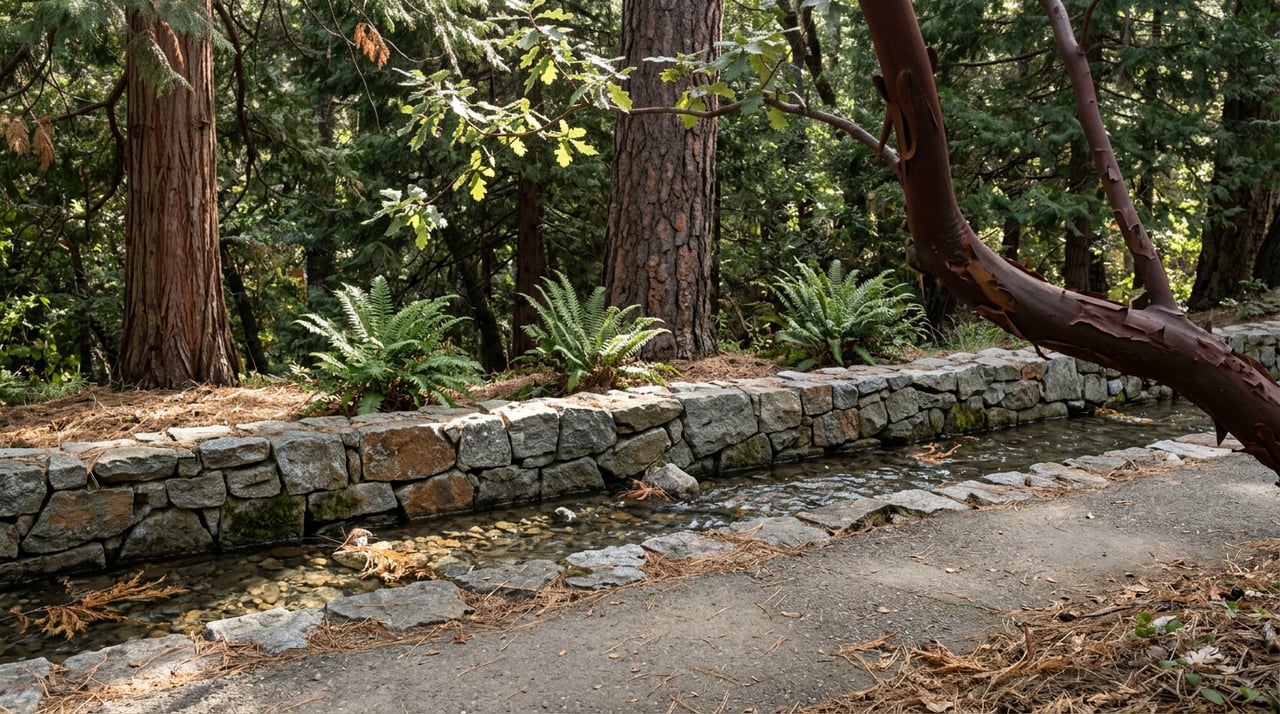
Every dog walker in Cedar Ridge has stood on that flat dirt shelf above the trees at some point and wondered the same thing: what is this thing, exactly, running along the hillside in a line too straight for a creek and too old for anyone's driveway? It shows up behind houses on Kewin Mill Road, cuts along the ridge near Comstock Ranch, and disappears into the pines without a trailhead sign or a mile marker. Most people who walk it never learn its name.
It has one. It is part of the Tuolumne County Ditch System, and the specific stretch behind Cedar Ridge is called the Main Canal. It was not built for you, and it was not built to be a trail. Understanding why it exists, and why you are still allowed to walk it, tells you something true about how this neighborhood actually runs: almost nothing here was built for residents on purpose. It was left behind by somebody else's decision, and the community picked it up.
A Line PG&E Decided to Keep
The ditch itself predates the county, the fire department, and every house in Cedar Ridge by decades. Developers dug the first channels in the early 1850s to move water from the South Fork of the Stanislaus River down to mining operations at lower elevation. Pacific Gas and Electric entered the picture later, building Strawberry Reservoir at Pinecrest and Lyons Reservoir, and began routing a share of the river's flow for power generation.
For a long stretch, PG&E owned the whole network. That changed in 1893, when the state Public Utilities Commission ordered the company to pipe the entire system rather than let it run as open ditches. PG&E's response was not to comply. It handed 57 miles of the ditches over to Tuolumne County's water division, which was not bound by the same PUC order. The company kept the two reservoirs for itself, along with one more piece: the Main Canal, the stretch that runs through Cedar Ridge.
That detail matters more than it looks. The ditch behind Cedar Ridge is not the leftover the county ended up managing after PG&E walked away. It is the one segment PG&E decided was worth holding onto. More than 60 miles of the historic system now connect Twain Harte, Tuolumne, Columbia, Sonora, Jamestown, and Cedar Ridge, according to Cedar Ridge Ranch's own history of the ditch, and the piece running past your neighborhood is a private utility company's asset, not a county trail.
What the 1978 Resolution Actually Allows
That ownership question explains something else: why there is no signage, no groomed surface, and no official designation as a hiking trail anywhere along the route. Access to the service paths that run beside the ditch is governed by Tuolumne Utilities District Resolution 78-03, adopted in 1978, not by any parks department trail plan. The paths exist so utility crews can reach the water route for inspection and maintenance. Residents have simply been permitted to use them since.
If you have ever wondered why the surface changes character block to block, sometimes graded gravel, sometimes just packed dirt with exposed roots, that is the reason. Nobody engineered it as a continuous recreational corridor. It is a maintenance easement that happens to connect a good stretch of the neighborhood on foot.
A few practical things follow from that:
- The path is a working utility corridor, so expect occasional maintenance activity or equipment parked along it, particularly after storms.
- There is no posted mileage or loop map, because none was ever built for hikers. Locals navigate it by cross streets, not trail names.
- Because it is privately owned infrastructure with permitted public access rather than a dedicated park, the rules for use trace back to the 1978 resolution rather than any county recreation code.
None of that makes it less useful. It just makes it worth knowing what you are actually walking beside.
Six Seats, One Firehouse
The same pattern, county or utility infrastructure absorbed and run by the people who live near it, shows up again a short drive from the ditch, at the volunteer fire station on Kewin Mill Road near Mount Elizabeth Drive.
Station 58 is a Tuolumne County Fire Department station, but it carries no full-time paid staff. The county's own fire station directory lists it as a volunteer station, and Cedar Ridge Ranch's recruitment page for the department spells out what that means day to day: the department's engines are ready, but the people staffing them are unpaid neighbors who hold other jobs and get paged out by radio when a call comes in.
| Station 58, Cedar Ridge | Detail |
|---|---|
| Location | 24190 Kewin Mill Road, Sonora |
| Staffing | All-volunteer, unstaffed by paid personnel |
| Nearest paid station | Twain Harte |
| Roster described on recruitment materials | 5 firefighters and 1 trainee |
| Stated staffing goal | 18, to reliably fill six engine seats |
Run the numbers on that roster and the arithmetic is not complicated. Six seats need filling on any given call. The recruitment page describes a working roster of five firefighters and one trainee, six people total. There is no slack in that math. If one person is out of town, sick, or simply asleep when the pager goes off, the engine runs short.
That is not a statement about how safe or unsafe Cedar Ridge is. It is a statement about how the department actually functions: not as a fully staffed backstop, but as a small group of specific neighbors whose availability is the whole system. The county built the station and supplies the equipment, training reimbursement, and a quarterly stipend for qualifying volunteers. Everything past that, the depth of the roster, is up to who in Cedar Ridge decides to sign up.
The Auxiliary That Formalized Itself in 2025
The organization that fills the gaps the county doesn't cover is the Ladies Auxiliary of Cedar Ridge, and it changed its own structure recently enough to matter. Through 2024, the group operated as the Ladies Auxiliary of the Cedar Ridge Volunteer Fire Company. At the start of 2025, it renamed itself and became a standalone nonprofit organization, with its own site at lacrtc.com. Sandy Kelley serves as president, Terri Ryan as vice president, Cathie Lobdell as secretary, and Nola Eckley as treasurer.
What the auxiliary actually funds is specific and not glamorous: uniform shirts and patches for volunteers, boot allowances, and membership at Dogwood Lake for the firefighters themselves, benefits the county's own funding does not cover. The department's recruitment materials list these directly as auxiliary-funded, separate from what Tuolumne County Fire Department provides through training, protective gear, and workers' compensation.
The auxiliary's largest annual fundraiser is the Fireman's Barbecue, held at Cedar Ridge Lake. The 2025 event ran on a Saturday in late June, from 2 to 6 p.m., and was listed on myMotherLode's community events page alongside other Mother Lode nonprofit fundraisers. It is not a county event or a chamber event. It is neighbors funding the equipment and small comforts that keep six volunteers willing to keep answering pages.
Nothing Here Was Built for You
Put the ditch and the fire company side by side and the pattern is the same one twice. Cedar Ridge did not get a developer-built trail system. It got a maintenance road that PG&E kept for itself in 1893 and never bothered to fence off, governed today by a 1978 utility resolution nobody thinks about while walking their dog. Cedar Ridge did not get a fully staffed fire department either. It got a county station, six engine seats, and a roster that depends entirely on whether enough neighbors show up to fill them, backed by an auxiliary that only became a formal nonprofit last year.
Neither piece of infrastructure was designed with this specific community's convenience in mind. Both work because people who already live here decided to make them work: walking the service road instead of waiting for a trail system, or joining the roster and the auxiliary instead of waiting for the county to hire full-time crews. That is a different kind of neighborhood character than "quiet" or "wooded," and it is the one that actually explains why things run the way they do up here.
If you are curious about more of what makes Cedar Ridge tick, from the housing stock to the drive times to the details that only show up once you live somewhere, Healy Homes keeps notes like this on every Tuolumne County neighborhood we work in. When you are ready to talk specifics about your own property here or anywhere else in the Sierra Foothills, Request Your Free Home Valuation and we'll walk you through what your place is actually worth today.